
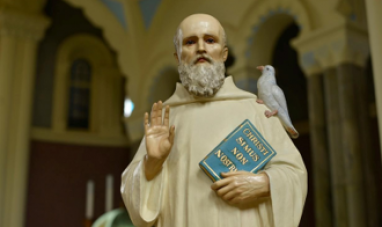
Fr Sean McDonagh gave the following homily at an ecumenical service in Bangor Abbey, County Down, Northern Ireland, yesterday.
Good evening and thank you for inviting me here to preach at this Columban service in Bangor Abbey. As a Columban missionary, it is a great privilege for me to join with you in this ecumenical celebration of the life and legacy of St Columban - particularly his sensitivity to all God's creation which is very much needed in today's Churches and world.
Everything in nature is interdependent and interrelated. All people are my sisters and brothers, and all creatures are my companions and care, and respect should mark how I deal with them.
Unfortunately, many Christians, down through the ages, did not believe in kinship or compassion between human beings and other creatures. According to St Augustine "reason has not been given to animals and so, by the most just ordinances of the Creator, both their lives and their deaths is subject to our use." Thomas Aquinas was even more convinced that animals had no ethical value. He wrote that "we have no duties of charity, nor duties of any kind to the lower animals, as neither we have for sticks and stones." This view of creation that believes the world is inert and even dead and humans can simply use nature for almost any purpose, was also held by both Martin Luther and John Calvin. Luther's contrast between the Kingdom of Heaven which operated under God's grace and the Kingdom of the World which operated under God's wrath intensified the split between the 'material' and 'spiritual' dimension of the Earth which was already deeply embedded in Western culture and religion.


Comments (0)