
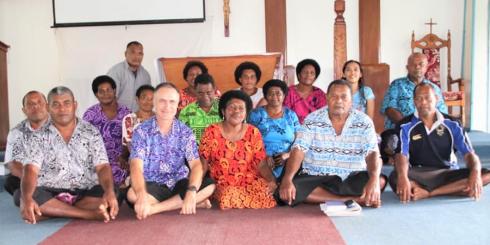
From May 11-13 this year, a small group of Columban companions represented by myself, Josefa Vasakula (National Coordinator) and LM Jennifer (Jake) Lunor led a workshop, in Fijian, on the meaning of the Liturgy, especially the Eucharist, given that we are in a time when the vast majority of Catholics are being denied access to Mass, except online. The ideas for the seminar were prepared by a liturgist Sr Carmel Pilcher, who had given input to our 2 Spiritual Year students a few weeks previously.
We learnt that ‘liturgy’ originally meant ‘work of the people’ (in civic society), and obviously now means our sacred priestly work as the baptised in offering our thanks to God and our service to the community, especially the poor. We recalled Vatican II’s famous statement: ‘The Liturgy is the summit toward which the Church is directed... at the same time it is the source from which all the Church’s power flows’ (CSL 10) and asked the villagers to share about the importance of their own water source and the summit on which their elders had built the church. We also recalled that Christ is present in the liturgy in four ways:
- in assembly (community) gathered in his name
- in the person of the minister (priest or his delegate)
- in his word
- under the Eucharistic species (GIRM 27).
At this time of COVID, although we longer have the Eucharistic species being shared, or the priest presiding, we still have vibrant family communities who share the word of God together, so in no sense has Christ withdrawn from us. In fact, this may be a graced time for us to re-emphasize those aspects of the liturgy which were underestimated in our overemphasis on the role of the priest, and/or the fact of ‘receiving communion’.
Those loving acts have not stopped in the time of COVID, in fact they have intensified.
In our second session, we looked at the meaning of Christian sacrifice (given the Mass is often called ‘the Holy Sacrifice’). As opposed people “sacrificing” chocolate in order to lose weight or gain money, Christian sacrifice is always a loving act for someone else and it is all those acts that we bring to Mass every Sunday, and that are gathered up in Christ’s supreme loving act of giving himself to the Father and to us. Those loving acts have not stopped in the time of COVID, in fact they have intensified.
In the final session, ‘Bread Broken and Shared’, we remembered Pope Benedict XVI’s phrase ‘Love for the poor and liturgy go hand in hand, love for the poor is liturgy.’ In fact, “Only from the Eucharist, from the prophetic gesture of the breaking of the bread, can the Christian communities renew their awareness that the church cannot be the body of Christ where Christians fail to turn away from egoism and refuse to share their goods with the poor. That which is not shared with others in communion is taken from others in injustice”. (Boselli: Spiritual Meaning of Sacrifice, 205-6)
The villagers of Doguru were very grateful for this time of renewal, and although we could only accommodate 15 people because of restrictions or neither could we celebrate the Eucharist, they felt empowered to carry the teaching to their own communities, so that when Mass does resume, we will hopefully all think and act differently about it. We’ll leave the last word to St Augustine (a sermon to the newly baptised):
“If, you are the body of Christ and His members, your mystery has been placed on the Lord’s table, you receive your mystery”. You reply “Amen” to that which you are… Be a member of the body of Christ so that your “Amen” may be true!
Columban Fr Patrick Colgan is the Spiritual Year Socius in Suva, Fiji.


Comments (0)