
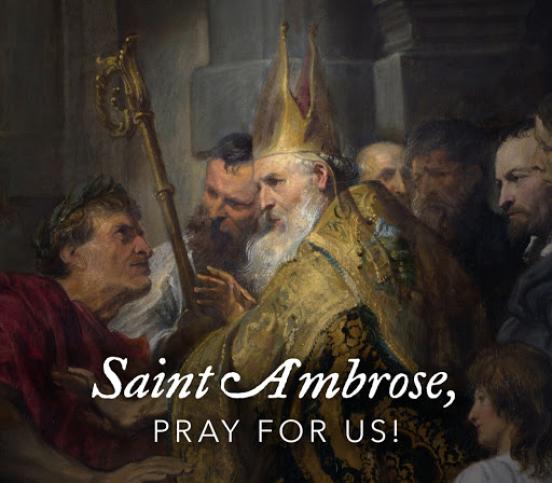
One of Ambrose’s biographers observed that at the Last Judgment, people would still be divided between those who admired Ambrose and those who heartily disliked him. He emerges as the man of action who cut a furrow through the lives of his contemporaries. Even royal personages were numbered among those who were to suffer crushing divine punishments for standing in Ambrose’s way.
When Empress Justina attempted to wrest two basilicas from Ambrose’s Catholics and give them to the Arians, he dared the eunuchs of the court to execute him. His own people rallied behind him in the face of imperial troops. In the midst of riots, he both spurred and calmed his people with bewitching new hymns set to exciting Eastern melodies.
In his disputes with Emperor Auxentius, he coined the principle: “The emperor is in the Church, not above the Church.” He publicly admonished Emperor Theodosius for the massacre of 7,000 innocent people. The emperor did public penance for his crime. This was Ambrose, the fighter sent to Milan as Roman governor, and chosen while yet a catechumen to be the people’s bishop.
There is yet another side of Ambrose—one which influenced Augustine of Hippo, whom Ambrose converted. Ambrose was a passionate little man with a high forehead, a long melancholy face, and great eyes. We can picture him as a frail figure clasping the codex of sacred Scripture. This was the Ambrose of aristocratic heritage and learning ...
Saint of the Day, Franciscan Media
 |
Click here to view in pdf! |


Comments (0)